

Storytelling-and-Civic-Engagement-Highlight-RVCs-MLK-Observance.php
Storytelling and Civic Engagement Highlight RVC's MLK Observance
Rock Valley College observed the National Day of Racial Healing, focused on Dr. Martin Luther King Jr.’s message of justice and community.
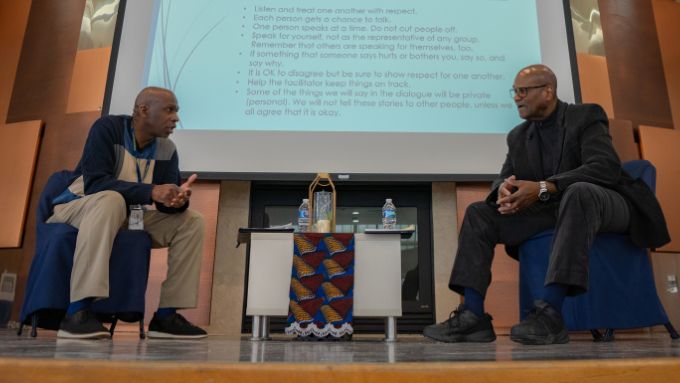
Dr. Keith Barnes and Mr. Eldridge “Skip” Gilbert guided conversations grounded in Dr. King’s 1967 speech, “The Three Evils of Society.”
The event, A Day of Storytelling: The Beloved Community—MLK as a Drum Major for Justice, took place on Wednesday, January 21 from 1 to 2:30 p.m. in the Stenstrom Student Center Atrium as part of the college’s MLK Observance.
The National Day of Racial Healing invites communities to confront the realities of racial injustice while working toward understanding, trust, and progress. Dr. Keith Barnes, Vice President of Culture & Belonging and Mr. Eldridge “Skip” Gilbert, an independent educational services contractor and former RVC adjunct professor, guided conversations grounded in Dr. King’s 1967 speech, “The Three Evils of Society,” in which he challenged the nation to confront the evils of racism, poverty, and militarism as connected societal injustices.
The observance centered on shared dialogue, reinforcing the idea that meaningful change often begins with honest conversations and lived experiences. This approach reflected Dr. King’s vision of the “Beloved Community,” a society built on justice, compassion, and mutual responsibility.
Mr. Gilbert attended Illinois Wesleyan in the 1960s, where he was the only African American male student in his graduating class of 400. “My presence meant I had to succeed—not just for myself, but to open the door for others who would come after me.” That experience shaped his understanding of leadership, responsibility, and the importance of creating opportunities for change.
During his time at Illinois Wesleyan, when American professional baseball player Jackie Robinson was invited to speak on campus but became too ill to travel, Mr. Gilbert consulted his father, a Baptist minister with connections to Dr. Martin Luther King Jr. Through those connections, Dr. King was invited to speak instead. “Dr. King said he visited college campuses because students were the foot soldiers of the Civil Rights Movement,” Mr. Gilbert said. “He believed young people were essential to creating change.”
Dr. Barnes and Mr. Gilbert drew connections between King’s words and the realities facing communities today. Their discussion emphasized that the challenges King identified more than half a century ago remain. Instead, they continue to shape daily life, civic engagement, and the responsibility individuals have to one another. “Dr. King spoke about racism, economic inequality, and war in 1966, and that speech is just as relevant today, said Mr. Gilbert. “If he gave it yesterday, it would still speak directly to our reality.”
Barnes and Gilbert encouraged attendees to think critically about how justice is advanced not only through words, but through action.
The role of civic participation, particularly voting, is a powerful tool for change. In the spirit of Dr. King’s call to leadership, Dr. Barnes and Mr. Gilbert highlighted voting as one of the most direct ways individuals can influence policies, hold systems accountable, and help shape more equitable communities. Participants were reminded that exercising the right to vote and encouraging others to do the same are essential to sustaining the progress generations before fought to achieve.
Attendees were invited to consider how their own voices and choices contribute to racial healing, whether through dialogue, advocacy, or civic engagement. The conversation reinforced that racial healing is not a single moment or event, but a continuous process that requires commitment and participation from all.
In a final moment of reflection and call to action, Dr. Barnes shared a quote from Dr. King’s “The Three Evils of Society Speech: "So let us stand in this convention knowing that on some positions; cowardice asks the questions, is it safe; expediency asks the question, is it politic; vanity asks the question, is it popular, but conscious asks the question, is it right". He went on to say that sometimes an individual must take a stand that is "neither safe, nor politic nor popular; but he must do it because it is right".
Media Contact
- RVC Public Relations
- (815) 921-4510
- Email RVC Public Relations
- RVC Communications Page