

Engineering-our-Future-Celebrating-10-Years-of-RVC-NIU.php
Engineering our Future: Celebrating 10 Years of RVC+NIU
It’s been a decade since Rock Valley College (RVC), Northern Illinois University (NIU), and local industry leaders collaborated to create NIU Engineering at RVC.
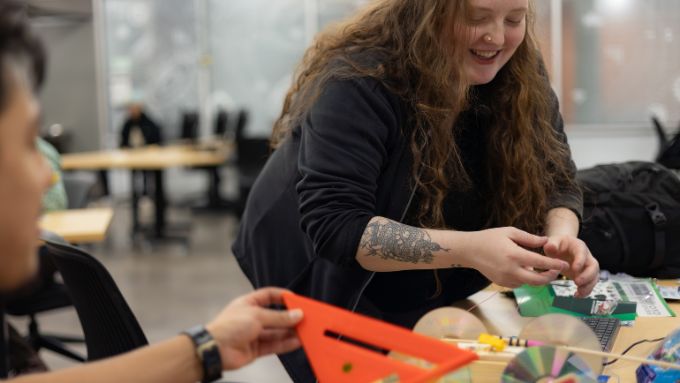
Students enjoy lab activities in Engineering 101 class at the Woodward Technology Center.
Since then, more than 100 students have graduated and been fast-tracked into employment in the Rockford area.
This community-based, industry-integrated program allows students to earn a Bachelor of Science in Mechanical Engineering (BSME) by completing their first two years at RVC before transitioning to NIU’s junior- and senior-level courses on RVC’s main campus. The professors’ years of hands-on experience and work with industry partners ensure that the curriculum prepares students effectively for regional workforce needs.
The ABET-accredited program offers individualized advising, small class sizes, and state-of-the-art laboratories, while maintaining high graduation rates and near 100% job placement. With support from 60 businesses, over 40 interns have gained experience with 20 regional companies. In the last academic year, 18 students completed the Associate of Engineering Science (AES) degree.
Sergio Ortiz, an AES student at RVC in his final semester, has worked toward his degree since fall 2024. By taking classes during the academic year and summer, he is on track to finish his general education courses and graduate, with plans to pursue his BSME at NIU.
“I chose this program mainly for cost-effectiveness; it’s convenient to attend college and stay close to home. As of right now, I am likely going to graduate with zero debt, which was a big factor,” Ortiz shared.
Student participation grows from quiet engagement into collaborative learning through study groups, problem-solving sessions, and close connections. “That’s the participation I think matters to them,” said Tom Clark, RVC’s Academic Chair and Associate Professor of Engineering. “It’s the one that got me through school.”
Clark created academic planning guides based on math readiness to help students manage coursework, stay on track, and reinforce that success is within reach.
Reflecting on his journey, Ortiz shared, “Getting an AES is a big-time commitment, but it's important to keep trying because the hard work pays off. Focus on math; everything builds off that.”
Many companies in the region will invest in their employees to earn both their AES and BSME degrees, underscoring the program’s strong ties to local industry. This link between RVC and NIU engineering students and area employers is stronger than ever.
Scholarships are available from the RVC Foundation, the Community Foundation of Northern Illinois, and the National Fluid Power Association further support students, helping many graduate debt-free and enter full-time roles with starting annual salaries between $85,000 and $89,000.
“I’m impressed with the number of students who work full-time and complete both degrees,” said Tim Spielman, RVC Director of Academic, Career, and Transfer Advising. “Often, employers are flexible with their schedules, which is a testament to the support this program has in the community.”
Spielman guides AES students through degree requirements, academic planning, and provides resources such as tutoring, Personal & Success Counseling, and Career Services.
“Use your resources; the engineering teachers want their students to succeed. They offer office hours, and it's important to go if needed,” Ortiz expressed. He added, “The tutoring center has people who have taken many engineering classes, which is a big help.”
Students can join the Fluid Power Club, a unique competitive team that has earned back-to-back national championships at the National Fluid Power Association's Fluid Powered Vehicle Challenge, gaining skills and hands-on experience that’s hard to find elsewhere.
As the NIU Engineering @ RVC partnership marks its 10th anniversary, the program continues to address the demand for local mechanical engineering talent, helping to ensure the continued success of a critical sector of the regional economy.
“I am glad I chose the program because of the teacher-to-student ratio. Many of my classes are smaller than the lecture-sized classes at other places, making it easier to get in contact with teachers, ask questions, and meet the people around me.”
Media Contact
- RVC Public Relations
- (815) 921-4510
- Email RVC Public Relations
- RVC Communications Page